Biodiversity has a seat at the business table.
For a long time, biodiversity has been treated as something businesses need to work around. Another regulation to comply with or report to produce, all potential obstacles to growth.
It's often associated with activism, climate change and the idea that doing good for the planet must somehow come at the expense of doing good business.
But what if biodiversity could actually help businesses make better decisions? After all, businesses often are the ones making some of the biggest decisions about our environment they are also the ones with the means to make a real difference.
Imagine, you've invested months of work and a considerable R&D budget into extending an airstrip or into an housing project. Everything is moving along nicely until someone discovers a protected species on the site.
Suddenly, your permits are at risk. You can challenge the decision, spend more money in court and potentially look like the company that doesn't care about the environment. Or you could have known much earlier.
A few environmental DNA (eDNA) samples and some drone scouting could have helped identify the risk before you committed to the project.
That's what E-BIOM makes possible.
So what if, instead of keeping biodiversity and business on opposite sides of the table, we gave them a reason to talk?
A team ready for a repositioning
Born as a university lab spin-off, E-BIOM uses environmental DNA sequencing and sampling to map biodiversity. A simple dirt or water sample can reveal every living thing in an ecosystem.
And the more samples they analyse, across different environments and countries, the more experience and reference data they build to interpret what those findings mean.
The applications are surprisingly broad. From helping developers anticipate environmental constraints to supporting public authorities in monitoring ecosystems. E-BIOM even helped the Belgian government track COVID-19 through wastewater analysis.
But collecting data is only half the story. The real value comes from turning it into information businesses can act on.
They're environmentalists. And realists.
When we met E-BIOM's founders, Jonathan and Véronique, what struck us wasn't just their expertise. It was how they approached the problem.
Like most people working closely with biodiversity, they have their own convictions about climate change and the environmental challenges ahead. But they're also very aware of how businesses operate.
They know that lecturing companies about their environmental responsibilities isn't always the best way to get them to act (read: isn't the way at all).
And they certainly don't want biodiversity to be left out of the conversation because it's perceived as an obstacle to doing business.
Jonathan, a PhD in Biological Sciences, comes from the research world. He's the scientist who can connect what's happening in the lab to the challenges his clients face.
Véronique brings a complementary perspective. With her background in business development, she makes that scientific expertise more accessible, practical and relevant to the people making decisions.
Together, they bring an interesting balance of scientific conviction and business pragmatism.
Making the science do more work
E-BIOM already had the technological expertise and the ambition to make something grand of it. What it needed was a clearer way to communicate its value beyond the scientific community.
Businesses don't necessarily need another biodiversity report. What they need to know is what the findings mean for their next investment, their operations, their growth opportunities or their ability to comply with regulations.
And importantly, they need to be able to stand behind those findings.
That's where scientific rigour becomes a business advantage.
E-BIOM's measurements follow reproducible methodologies, producing evidence that can be scrutinised and challenged scientifically. This makes the resulting indicators more defensible when decisions face regulatory or legal scrutiny.
It helps organisations anticipate risks in the short term, whether that's securing permits, meeting regulatory requirements, avoiding costly surprises or having more impact.
But it also helps them prepare for the longer term, as biodiversity commitments, regulations and expectations evolve.
In other words, E-BIOM's biodiversity intelligence is not only about knowing what's out there, but also about knowing what to do with that information.
So we worked with Jonathan and Véronique to sharpen their positioning around a simple idea:
Biodiversity intelligence belongs at the decision-making table.
Not as another CSR obligation, but as information that can influence how organisations invest, develop and grow.
We weren't trying to make the science look more like business. We were helping E-BIOM make the business value of its science impossible to ignore.
Connected Intelligence.
Once the positioning was clear, we moved on to the visual identity.
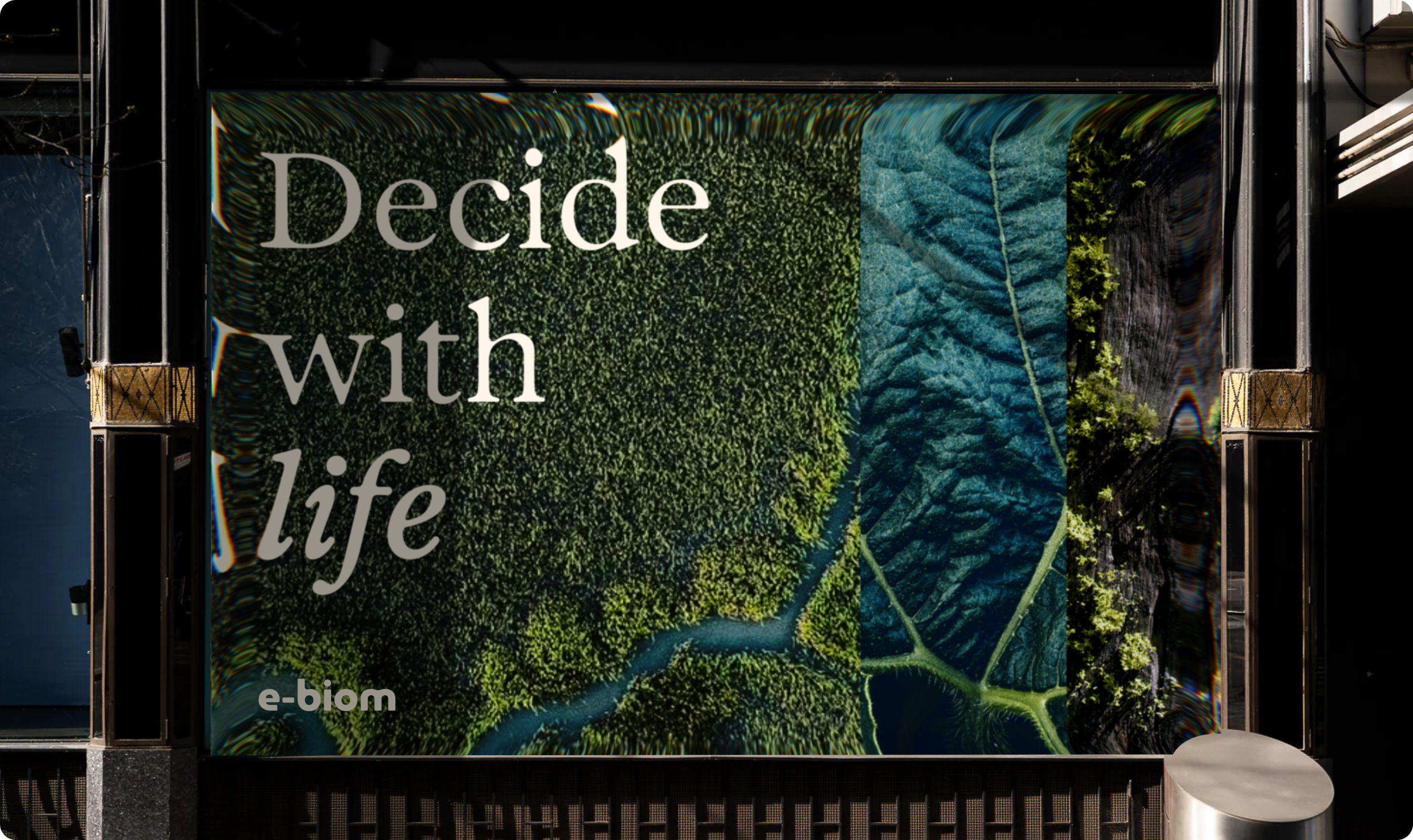
The design team developed a concept called Connected Intelligence. Rather than reaching for the usual environmental imagery, they found inspiration in how biodiversity actually works.
I'll let the team's words speak for themselves:
“As we explored what makes biodiversity unique, one idea kept coming back: ecosystems are not defined by their individual elements, but by the relationships between them. Their value comes from interaction rather than isolation.
We felt this was a much more interesting direction than relying on familiar environmental codes or symbolic references to nature. Instead, we imagined the identity as its own symbiotic ecosystem:
A system where typography, colour, photography and data each have a distinct role, but gain meaning through the way they interact. Sometimes they merge, sometimes they contrast, sometimes they overlap or respond to one another. Rather than relying on a single graphic device, the identity is designed to express relationships.
This creates a visual language that feels both scientific and human, structured yet alive, reflecting E-BIOM's role as the bridge between biodiversity and decision-making.”
Making room for biodiversity in the boardroom.
Today, E-BIOM has a positioning, messaging and visual identity that better reflect who they are and where they're heading.
Not a laboratory trying to look like a consultancy. Nor environmental activists trying to convince businesses to stop growing.
But a team of scientists and business-minded people who believe that better environmental intelligence can lead to better business decisions.
And perhaps that's the most interesting thing about working with Jonathan and Véronique.
They're not asking businesses to choose between biodiversity and their bottom line. They're showing them why understanding one can help protect the other.
Because if we want biodiversity to influence the decisions shaping our future, it needs to be part of the conversation where those decisions are made.


More good stuff
Building a brand on a universal feeling
Behind the brand: Neveo
Stop throwing shit at the wall
Or why brands without positioning aim like a blindfolded man with a shotgun.
VCs invest in founders. They exit companies.
A startup begins as something its founders believe. A brand becomes something other people believe too.